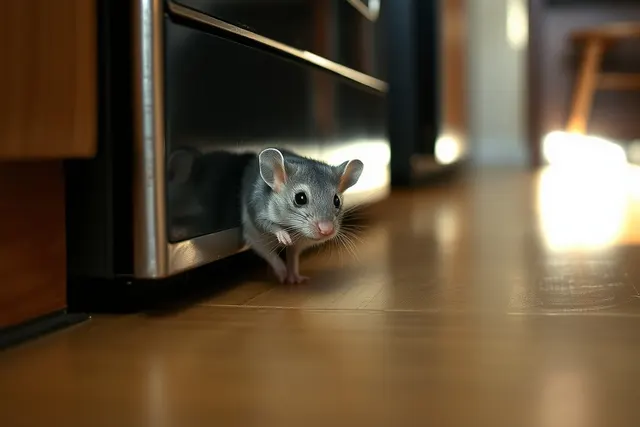
How to tell you have mice in the house
Mice are small and quiet, so the first sign is usually what they leave behind rather than seeing one. A single mouse can leave dozens of droppings a night, which is why people often think the problem is bigger or smaller than it really is.
- Droppings about the size of a grain of rice, pointed at the ends, scattered in drawers, along baseboards, behind the stove and inside the cabinet under the sink.
- Light scratching or skittering in walls or the ceiling at night, quieter and quicker than rat noise.
- Chewed corners on boxes of food, shredded paper towels or insulation pulled into a nest.
- A musky, ammonia-like smell in a closed cabinet or closet.
- Pets staring at or pawing at one spot on a wall or under an appliance.
If the droppings are much bigger, closer to a raisin, or you are finding holes outside in the dirt, read our rat removal page instead. The two jobs are handled differently.
Why mice come inside in Ohio
Field mice and house mice live outside in summer, in tall grass, woodpiles, garden beds and the edges of farm fields that still surround a lot of Ohio suburbs. When overnight temperatures drop into the 40s in October, they look for warm air leaking out of a house. A garage, a basement sill plate, or the space behind a dishwasher is perfect for them. We cover the timing in more detail in our guide on why mice come inside in the fall.
Once inside, a pair of mice can produce a new litter roughly every three weeks. That is why a problem that starts with one mouse in October can be a dozen by Thanksgiving.
What a mouse control visit includes
- Finding the runways. Mice travel the same paths along walls. The technician follows droppings and rub marks to where they enter the kitchen, basement or attic.
- Trapping. Snap traps or enclosed trap stations are placed along those runways, often in places you would never think to look, like on top of the sill plate in the basement or behind the dishwasher kick plate.
- Exterior stations if needed. When mice are coming in from outside in large numbers, locked stations along the foundation cut down the pressure.
- Sealing. Mice fit through gaps about a quarter inch wide. Gaps around pipes under the sink, the gas line behind the stove, garage door corners and weep holes in brick are packed with copper mesh and sealed. See rodent-proofing for the full list.
- Follow-up visits to check and reset traps, usually one to two weeks apart.
Most homes need two or three visits. Glue boards are sometimes used in tight spots, but many technicians avoid them in living areas because they are less humane and a stuck mouse is noisy.
How much a mouse exterminator costs
For an average Ohio house, mouse control usually runs $200 to $500 for trapping and follow-up visits. Sealing small gaps is sometimes included in that range when there are only a few; larger exclusion jobs on older homes are quoted separately.
| Mouse job | Typical range |
|---|---|
| Trapping program, 2 to 3 visits | $200–$500 |
| Sealing a handful of small gaps | $150–$400 |
| Whole-house mouse proofing | $400–$1,500 |
| Quarterly preventive service | $100–$200 per visit |
Prices go up for larger homes, finished basements where traps have to go behind panels, and houses where the mice have spread into the attic insulation. The Ohio rodent control cost guide breaks down the full picture.
Doing it yourself vs. calling for mouse control
One mouse seen once in a garage can often be handled with a few snap traps and a sealed bag of birdseed. Call for help when you are catching mice week after week, when you hear them in the walls or ceiling, when droppings show up in the kitchen or nursery, or when you cannot find where they are coming in.
Ultrasonic plug-in repellers and peppermint oil have little evidence behind them. Mice get used to the sound and the smell quickly. Steel wool on its own rusts away in a damp Ohio basement within a season; copper mesh holds up better.
Health concerns with mice
House mice can spread salmonella through droppings on food surfaces, and deer mice, which do get into Ohio cabins, sheds and garages near wooded areas, can carry hantavirus. Never vacuum or sweep dry droppings. Wet them with a bleach solution first, wait a few minutes, then wipe them up with paper towels while wearing gloves. Large amounts of droppings in an attic or crawlspace are better handled as a droppings cleanup job.
Where to put mouse traps in the kitchen and basement
Placement matters more than the trap. Mice run along edges and almost never cross the middle of a room. Set traps perpendicular to the wall with the trigger end touching the baseboard, behind and beside the stove and fridge, inside the cabinet under the sink, along the back of the pantry floor and on the basement sill plate. Use several traps a few feet apart rather than one or two, because a mouse may only travel a short distance from its nest.