Dayton, OH facts that affect rodent control
| Dayton fact | What it means for rats and mice |
|---|---|
| Seat of Montgomery County, where the Great Miami, Mad and Stillwater rivers meet | Riverbanks, levees and storm drains carry rats into nearby neighborhoods. |
| The 1913 Great Dayton Flood led to the levee and dam system of the Miami Conservancy District | Levee corridors are long green strips through the city that rats use as cover. |
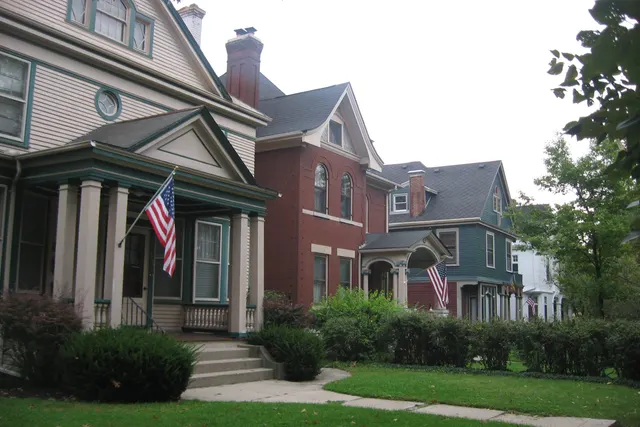
| Historic districts such as the Oregon District and St. Anne's Hill date to the 1800s | Stone and old brick foundations, coal chutes and closed-off fireplaces give rodents routes in. |
| Dayton has demolished many vacant homes in recent years | Demolition pushes rats next door; check your garage and foundation after a nearby teardown. |
Rivers, levees and rats in Dayton
Three rivers meet near downtown Dayton, and after the devastating flood of 1913 the city and the surrounding region built a system of levees and dams that still shapes the riverfront. The river corridors, levees and bike trails form long green strips through the city. Norway rats use riverbanks, culverts and storm drains as cover and highways, and homes and businesses near the rivers tend to see more rat activity.
If you live near the Great Miami or the Mad River and see rats in the yard, expect a rat job to include exterior stations along the foundation and garage, and burrow treatment along fences and outbuildings.
Historic neighborhoods and old foundations
The Oregon District, St. Anne's Hill and South Park preserve dense blocks of 19th-century brick homes and cottages. Dayton View, Five Oaks and Grafton Hill have larger homes from the late 1800s and early 1900s. Belmont and the eastern neighborhoods grew in the 1920s through the 1950s with bungalows and small frame houses.
The older the house, the more the rodent work focuses on the foundation: soft mortar between stones or old bricks, abandoned coal chutes, old cellar doors and gaps around lines added through masonry over the years. Historic homes also often have unusual voids, like closed-off fireplaces and old dumbwaiter shafts, that rodents use as highways.
Vacant property and rodent pressure
Like Cleveland and Akron, Dayton has lost population since its manufacturing peak and has a significant number of vacant homes and lots, and it has been demolishing many of them. Empty houses become rat and mouse nurseries, and demolition sends their residents next door. If a vacant house on your block was recently torn down, it is worth setting traps in your garage and basement and checking the foundation for new holes.
Rodents coming from a neglected neighboring property can be reported to the city, but treating your own home is what actually keeps them out. The rat removal page covers how that is done.
Mice in Dayton homes
Southwest Ohio is surrounded by farmland, and Dayton is no exception. Fall harvest in Montgomery, Greene and Miami counties pushes field mice toward town in September and October. Inside the city, mice are the most common rodent call, and the pattern is familiar: droppings in the kitchen, scratching in the walls at night, nests in stored boxes in the basement.
Bungalows and 1920s frame houses in Belmont, Walnut Hills and Linden Heights often have mice traveling through the walls from a gap at the sill plate. Trapping in the kitchen and basement plus sealing at the sill and utility lines handles most cases. See mouse control for the full process.
Rental housing in Dayton
Dayton has a large rental market, from single-family homes and doubles to apartment buildings near the University of Dayton and the medical district. Tenants should report rodent problems to their landlord in writing; Ohio landlords are generally responsible for keeping units fit and habitable. Landlords with several properties often save money by having them sealed together, especially doubles where mice move between units.
Rodent control cost in Dayton
Dayton prices tend to sit at or slightly below the statewide average. Mouse programs usually run $200 to $450 and rat programs $250 to $600. Sealing an older Dayton house with a stone or brick foundation often lands between $700 and $2,000. Newer homes in the suburbs are typically quicker to seal.
As always, ask for trapping and sealing priced separately, ask how many follow-up visits are included, and ask for the technician's Ohio pest control license.
Dayton rodent seasons
In the Miami Valley, mouse calls rise in October as nights cool and the surrounding fields are harvested, then hold steady through winter. Southwest Ohio winters are milder than in the north, so rats stay active outdoors longer and burrows along riverbanks, garages and alleys can be in use most of the year. Spring floods and high water on the rivers sometimes push rats out of low burrows toward nearby homes. Summer is the best time to seal older foundations, when the weather is right for mortar work.
Nearby communities around Dayton
Dayton is surrounded by suburbs and small cities: Kettering, Oakwood, Centerville, Huber Heights, Beavercreek, Fairborn, Trotwood, Riverside and others. Their housing ranges from early 1900s homes in Oakwood to postwar ranches in Kettering and newer subdivisions in Beavercreek and Centerville. The rodent patterns follow the housing: foundation and porch work on older homes, garage and utility-line sealing on newer ones, and more field mouse pressure wherever homes back onto farmland or woods.
Homes near Wright-Patterson Air Force Base and the large open areas around it also see field mouse pressure in fall.
Dayton neighborhoods we cover
- Oregon District
- St. Anne's Hill
- South Park
- Dayton View
- Five Oaks
- Belmont
- Old North Dayton
- Walnut Hills
- Linden Heights
- Patterson Park
- Westwood
- Kittyhawk