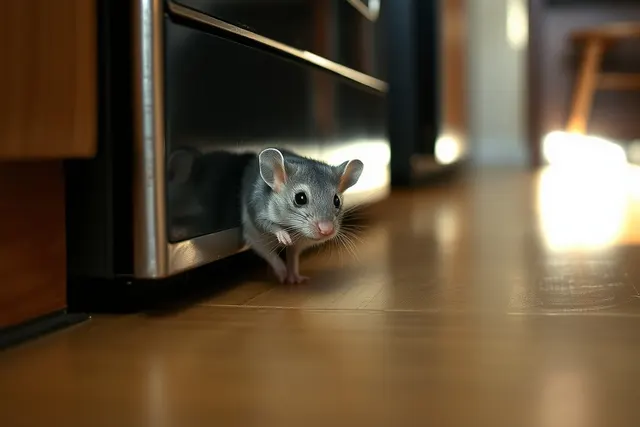
Field mice and new construction
Columbus has spread outward fast, and many newer neighborhoods sit right against fields that are still farmed or recently graded for the next phase of homes. Field mice that spend the summer in those fields lose their food and cover at harvest in September and October, or when bulldozers clear the next section. They move to the nearest buildings, which are the garages of the houses at the edge of the subdivision.
If you live in a newer home near open land, the most common pattern is mice in the garage first, then in the laundry room or kitchen next to it. Sealing the garage door corners, adding a sweep to the door into the house, and closing the gap where utility lines enter the garage wall usually stops it.
House mice in older Columbus homes
In Clintonville, Beechwold, Old North, the University District, Victorian Village, Olde Towne East and the South Side, houses are older and leakier. Mice come in at the sill plate, through basement windows and around utility lines, then travel up through the walls. Many of these homes are converted doubles or rentals with frequent turnover, which tends to mean food storage in cardboard, crowded kitchens and trash left at move-out: ideal for mice.
In these homes, mouse control focuses on the kitchen and basement, with sealing at the foundation, and works best when both units of a double are treated at once.
How a Columbus mouse visit works
- Inspect the garage, kitchen, basement and attic and trace droppings back to entry points.
- Set snap traps or enclosed stations along walls where mice travel.
- Seal the main gaps: garage door corners, house entry door, utility lines, sill plate and weep holes.
- Return one to two weeks later to clear traps and check for new activity.
- A final visit if needed, then early-warning traps left in the garage.
Mouse control cost in Columbus
Mouse trapping programs in Columbus usually run $200 to $500. Newer homes typically need $300 to $800 of sealing work, mostly at the garage. Older homes with stone or brick foundations can need $600 to $1,500. Doubles and small rentals cost more than a single unit but less than two separate jobs when treated together.
| Columbus home | Trapping | Typical sealing |
|---|---|---|
| New build near fields | $200–$400 | $300–$800 |
| Postwar ranch or Cape Cod | $200–$450 | $400–$1,000 |
| Older house or converted double | $250–$500 per unit | $600–$1,500 |
Ravine lots and attic mice
Homes along the ravines in Clintonville and other wooded corridors often get mice in the attic, sometimes alongside squirrels. If you hear scratching overhead at night, mice are likely; activity just after sunrise points to squirrels, which are a wildlife job rather than rodent control. Our page on noises in walls and attics covers how attic mice are trapped and the roofline sealed.
Columbus renters and landlords
Tenants should report mice to the landlord in writing with dates and photos. Ohio landlords are generally responsible for keeping rental units fit and habitable, and that usually includes rodent problems. Landlords with several rental houses in the University District or the South Side often save money by having all of them inspected and sealed in one round before fall, rather than responding unit by unit all winter.
What Columbus homeowners can do tonight
Look under the kitchen sink and behind the stove and fridge for droppings. Move dry goods and pet food into hard containers. Set snap traps flush against the wall where droppings are heaviest. In the garage, move seed and pet food into metal cans and look at the door corners for gaps. If the droppings are large and blunt rather than rice-sized, you may be dealing with rats; see rat removal in Columbus.
Garage checklist for Columbus homes
- Look at the bottom corners of each garage door in daylight with the door closed. Any light showing means a gap.
- Run your hand along the bottom seal; cracked or flattened rubber needs replacing.
- Check where the garage slab meets the house foundation for gaps or cracks.
- Look at where the A/C line set, water line and electrical service pass through the garage wall.
- Make sure the door from the garage into the house has a sweep and closes tightly.
- Move seed, pet food and grass seed into metal cans and get cardboard off the floor.
Most newer Columbus homes that get mice have at least two of these issues. Fixing them before October is the cheapest rodent control there is.
Signs your Columbus mouse problem is in the walls
If you are catching mice in the kitchen but also hear scratching in a bedroom wall or ceiling, the mice have found the wall cavities. In older Columbus homes this often happens through gaps at the sill plate or around pipes, and in newer homes through the garage wall. Treatment then has to include trapping where the wall cavities open, typically in the basement, the attic or under appliances, and sealing at the entry. It rarely requires opening drywall unless a mouse has died inside.
Read the full mouse control overview for Ohio or go back to rodent control in Columbus.