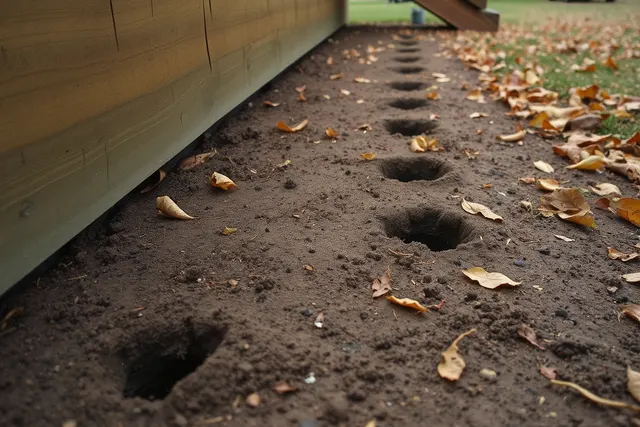
How to recognize rat burrows
Rat burrows have a few telltale features that separate them from chipmunk, vole or mole holes:
- Openings about two to four inches across, often with a fan of loose dirt pushed out in front.
- Smooth, packed edges from repeated use, sometimes with a visible worn path in the grass leading to them.
- Locations against something solid: a foundation, a slab edge, the underside of a deck, a shed floor, a railroad tie retaining wall.
- Often more than one hole: a main entrance and one or two escape holes nearby.
Chipmunk holes are smaller, neat and with no dirt pile. Vole damage looks like shallow surface runways in grass. Moles leave raised ridges and volcano-shaped mounds.
What draws rats to an Ohio yard
Rats stay where there is food, water and cover. In Ohio suburbs and city neighborhoods the usual draws are:
- Bird feeders, especially the seed that falls onto the ground beneath them.
- Pet food left outside or stored in bags in the garage.
- Compost bins and open garbage cans, especially with food scraps.
- Vegetable gardens and fruit trees in late summer.
- Woodpiles, junk piles, dense shrubs and ivy against the house.
- Neighbors with any of the above, since rats travel up to a few hundred feet from the burrow to feed.
Older city neighborhoods with alleys, detached garages and shared fences tend to see more rat pressure than newer subdivisions, but no area is immune.
How rat burrow treatment works
- Mapping. The technician finds every active burrow, follows runways, and looks for the food source.
- Treatment. Depending on the location and pets in the yard, active burrows may be treated with a registered burrow product, or rats are trapped in locked trap stations placed along runways.
- Locked stations along the foundation, garage and fence line to catch rats moving through.
- Collapsing and filling burrows after activity stops, sometimes with gravel or wire mesh at the base of decks and sheds to stop re-digging.
- Checking the house itself for entry points, since outdoor colonies often have already found a way into the garage or basement. That part is covered on rat removal.
Rats in the garage
The garage is the most common place Ohio homeowners first see a rat. It is warm, it often has a gap at the bottom of the door, and it is full of food: birdseed, grass seed, dog food, trash cans. Rats in the garage usually burrow nearby outside and come in at night.
Fixing it means three things: store all food in metal or hard plastic bins with lids, replace the door bottom seal and add rodent-proof corner guards, and trap the rats that are already using it. See our rodent proofing page for the sealing side.
Cost of rat burrow treatment in Ohio
| Job | Typical range |
|---|---|
| Burrow treatment, a few active holes | $200–$400 |
| Under-deck or under-slab colony | $350–$600 |
| Deck or shed perimeter wire barrier | $400–$1,200 |
| Exterior station service, ongoing | $35–$70 a month |
Costs rise with the number of burrows, how hard they are to reach and whether a wire barrier is added around a deck or shed. Ask how many visits are included.
Keeping rats out of the yard for good
Treatment clears the current colony; changes to the yard keep new rats from moving in. Hang bird feeders away from the house with a seed tray, or take them down for a season. Keep compost in a closed bin with a solid bottom or wire mesh underneath. Stack firewood off the ground and away from the foundation. Trim shrubs and ivy so there is a clear strip along the walls. Talk to neighbors if you can, because a rat problem rarely stops at a property line.
Rats and the house itself: decks, porches and slabs
Ohio rats love anything that creates a dry, sheltered space at ground level next to a house. Low wooden decks are the top spot because the soil under them stays dry and nobody looks there. Concrete patios and stoops are next: rats tunnel under the edge where the slab meets the soil and hollow out a nest beneath it. Over time, that tunneling can undermine the slab and cause it to crack or sink at one corner.
Front porches on older Ohio houses often have a lattice skirt that rats push through easily. Replacing the lattice with hardware cloth behind it, buried a few inches into the soil and bent outward in an L shape, stops them from digging under. The same L-shaped wire footer works around sheds and low decks, and it is often the single best long-term fix for a yard that keeps getting rats year after year.
Rats in sheds and chicken coops
Backyard chickens have become common across Ohio suburbs, and spilled feed is a powerful rat draw. If you keep chickens, store feed in metal cans, take feeders in at night or use a treadle feeder that closes when a hen is not standing on it, and set the coop on a base of hardware cloth so rats cannot tunnel up from below. Sheds with wooden floors set directly on the ground are another favorite nesting spot; raising the shed on blocks with an open gap underneath makes it much less attractive.