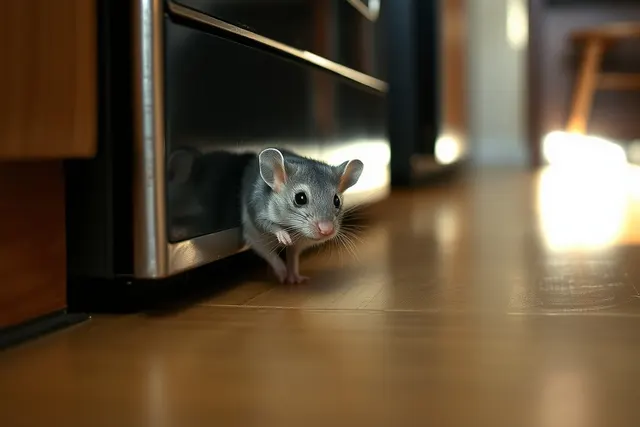
How mice get into Cincinnati homes
Old brick is porous and imperfect. In Cincinnati's 19th-century neighborhoods, mice find gaps where wooden joists sit in pockets cut into brick walls, where window frames have pulled away from the masonry, and where generations of gas, water, electric and cable lines were punched through foundations. In detached homes in Westwood, Mount Airy, College Hill and Pleasant Ridge, the familiar routes apply: the sill plate, basement windows, weep holes in brick veneer and the garage.
Once inside, mice follow pipes and wires upward. In a three-story Italianate in Over-the-Rhine or Mount Auburn, that can put mice in a top-floor kitchen within days of entering a cellar.
Attached homes and shared walls
Mice in a Cincinnati rowhouse rarely belong to just one house. Joist pockets in the party wall, shared cellars and old shared chimneys let them move between homes. If you are catching mice steadily and the house next door has the same problem, the most effective approach is to treat both at once, trapping in both kitchens and cellars, and seal the party wall gaps from each side.
In condo buildings and converted multi-unit homes, building management usually arranges treatment across all units. Report activity in writing with dates.
What a Cincinnati mouse visit includes
- A walk-through from cellar to attic, tracing droppings and rub marks to the entry points.
- Snap traps or enclosed stations placed along runways in the kitchen, cellar, and any upstairs rooms with activity.
- Close inspection of party walls in attached homes.
- Sealing of gaps with copper mesh, mortar, hardware cloth and sealant.
- Follow-up visits, usually one to two weeks apart, to clear traps and confirm the activity has stopped.
Mouse control cost in Cincinnati
A Cincinnati mouse trapping program typically runs $200 to $500. Homes with three floors or party walls fall toward the higher end because they take more traps and more inspection time. Sealing work on an older brick home often runs $400 to $1,200 depending on the number of joist pockets, windows and utility penetrations. Newer homes in the outer neighborhoods often need only $300 to $600 of sealing.
| Cincinnati home | Trapping | Typical sealing |
|---|---|---|
| Detached postwar house | $200–$400 | $300–$600 |
| Older detached brick or frame | $250–$500 | $400–$1,000 |
| Attached rowhouse, 2 to 3 floors | $300–$500 | $500–$1,200 |
Hillside and wooded neighborhoods
Cincinnati has a surprising amount of woodland on its hillsides, in parks like Mount Airy Forest, Ault Park and the hillsides above the Ohio River. Homes on wooded lots in Mount Airy, Mount Washington, Westwood and Clifton get deer mice and white-footed mice in addition to house mice. These mice often show up in garages and sheds first. Follow the wet-and-wipe cleanup method for their droppings in enclosed spaces, and never sweep them dry.
Tips for Cincinnati homeowners this season
Check behind the stove, under the sink and in the pantry for droppings in late October and November. Move dry food into hard containers. Set a few snap traps against the wall with a dab of peanut butter. In older homes, look at the cellar walls with a flashlight where floor joists meet the brick; you are looking for gaps around the wood. In a rowhouse, talk to your neighbors before winter sets in. If you also see larger droppings in the cellar or yard, read about rat removal in Cincinnati, because the two problems need different approaches.
Cincinnati housing types and how mice use them
Each common kind of Cincinnati home has its own mouse pattern. Italianate rowhouses in Over-the-Rhine, Pendleton and Mount Auburn have tall, narrow layouts with stairs running the full height of the house and shared walls on both sides; mice move vertically through plumbing chases and horizontally through party walls. Brick and frame houses in Northside, Walnut Hills and East Price Hill often have shallow cellars with stone walls, plus rear additions where the kitchen was moved over the decades; the joint between the original house and the kitchen addition is a frequent entry point.
Postwar homes in Westwood, Mount Airy, Finneytown and the western hills are typically brick ranches and Cape Cods on block foundations, with mice coming in at weep holes, the sill and the garage. Newer homes in the outer neighborhoods and suburbs leak mainly at the garage and utility lines.
Knowing which pattern your house fits makes it easier to judge a quote. A rowhouse job should mention party walls; a Cape Cod job should mention knee walls and the attic; a newer house should focus on the garage.
Food storage habits that keep Cincinnati kitchens clear
Mice in a kitchen are always following food. Cincinnati kitchens in older homes often have deep pantries, cabinets with open backs against exterior walls, and gaps around radiator pipes, all of which give mice cover close to food. Store dry goods, cereal, flour, rice and pet food in glass, metal or hard plastic containers with tight lids. Wipe up crumbs under the toaster and around the stove, and do not leave pet bowls full overnight. Taking away easy food makes traps far more effective, because a hungry mouse goes for the bait.
Check the backs of lower cabinets with a flashlight. Gaps where pipes come through the wall or floor are among the most common indoor entry points, and they are easy to pack with copper mesh.
Read the full mouse control overview for Ohio or go back to rodent control in Cincinnati.