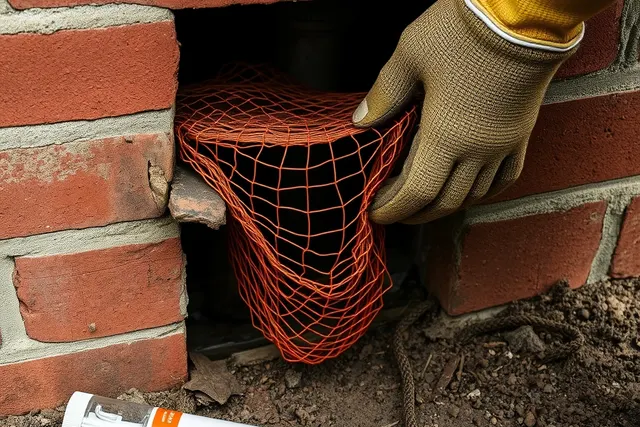
What rodent exclusion actually means
Exclusion is the trade term for physically closing every opening a rodent can use to get into the house. It is a building job as much as a pest job: a technician spends most of the visit on a ladder, on their knees along the foundation, or in the crawlspace, finding gaps and closing them with materials rodents cannot chew.
Done well, it is the single most effective thing you can buy for a recurring mouse or rat problem. Done poorly, with foam and caulk alone, it looks finished and fails within weeks.
Common entry points on Ohio homes
Every house is different, but the same handful of spots show up again and again on Ohio inspections:
| Entry point | Why it leaks | Typical fix |
|---|---|---|
| Garage door corners | Rubber seal tears, slab settles, mice chew the corner | New bottom seal plus rodent-proof corner guards |
| Utility penetrations | Gas, water, cable and A/C lines through siding or brick | Copper mesh packed tight, sealed over |
| Brick weep holes | Designed openings at the base of brick veneer | Stainless or plastic weep vents that keep airflow |
| Sill plate gaps | Where wood framing sits on the foundation | Mesh and sealant from inside the basement |
| Roof returns and soffits | Gaps where roof lines meet, mostly for mice | Hardware cloth or sheet metal flashing |
| Dryer and bath vents | Flaps stuck open or missing | Rodent guard vent covers |
| Old coal chutes and windows | Common in pre-1950 Ohio basements | Sheet metal or mortar closure |
In older Ohio neighborhoods with stone or rubble foundations, failing mortar is often the biggest issue. In newer subdivisions, gaps tend to be at the garage and around HVAC lines.
Materials that keep rodents out
The rule is simple: if a rodent can chew it, it does not count as a seal. Rats can chew through foam, plastic, wood, aluminum screen and soft mortar. Mice can do most of the same.
- Copper mesh: packed into gaps around pipes and wires; does not rust like steel wool in damp basements.
- Hardware cloth (galvanized, quarter inch or smaller): for vents, crawlspace openings and soffit gaps.
- Sheet metal flashing: for larger holes and chewed corners of wood framing.
- Mortar or concrete patch: for foundation cracks and old openings.
- Sealant over the top: used to hold mesh in place and keep weather out, never as the barrier itself.
Rodent proofing cost in Ohio
Most Ohio homeowners spend $300 to $2,500 on exclusion. The low end covers a newer house with a few gaps at the garage and utility lines. The high end is an older two-story with a fieldstone foundation, many weep holes and work needed at the roofline.
| House type | Typical exclusion range |
|---|---|
| Newer ranch or split-level, slab or poured basement | $300–$800 |
| 1950s to 1970s brick or frame with block basement | $600–$1,500 |
| Pre-1940 two-story with stone foundation | $1,000–$2,500 |
| Roofline and soffit work added | $300–$900 more |
Ask whether the quote lists each entry point, and whether trapping is included or separate. Exclusion should come after or alongside rat removal or mouse control; sealing rodents inside the house only moves the problem into the walls.
Timing: when to rodent-proof
Late summer and early fall is the best time in Ohio, before mice start moving indoors when nights cool off. That said, exclusion works any time of year, and winter work is common because that is when people discover the problem. Exterior mortar and sealant need temperatures above freezing to cure properly, so a technician may close gaps with mesh and metal in January and come back to finish the sealant in spring.
What to ask before you hire someone to seal your house
- Which entry points did you find, and will they be listed on the invoice?
- What material will you use in each spot?
- Will you check the roofline and attic, or only ground level?
- Is trapping inside the house included?
- What does a return visit cost if activity continues? Ask about their own warranty terms in writing.
Rodent proofing older Ohio houses vs newer builds
On a house built before about 1950, the biggest openings are usually at the foundation itself: soft lime mortar that has washed out between stones, old coal chutes, abandoned dryer or stove vent holes, and the spot where the original sewer and water lines came through the wall. Basement windows with rotted wood frames are another common entry. The sealing work on these houses is part pest control and part masonry repair.
On houses built since the 1980s, the foundation is usually tight and the gaps are almost all in what was added later: the A/C line set, the cable and internet line, the outdoor outlet, the hose bib, the gas meter. Garages with a door that has settled or a weather seal that cracked in a hard winter are the other main entry. These jobs tend to be faster and less expensive, which is why exclusion prices in newer Ohio subdivisions sit near the low end of the range.