Columbus, OH facts that affect rodent control
| Columbus fact | What it means for rats and mice |
|---|---|
| Ohio's capital and largest city, seat of Franklin County | Fast growth puts new subdivisions next to farmland, where harvest pushes field mice into garages. |
| The Scioto and Olentangy rivers meet downtown; Alum Creek and Big Walnut Creek cross the east side | River and creek corridors are rat highways; nearby homes benefit from year-round exterior stations. |
| German Village has small brick cottages from the 1800s | Old masonry foundations and alley garages call for mortar and metal sealing, not foam. |
| Clintonville and Beechwold are cut by wooded ravines | Ravine lots get deer mice and squirrels; noise timing tells which is in the attic. |
| The University District has a large stock of older rental houses | Move-out trash and crowded kitchens feed mice; landlords get best results sealing whole buildings. |
A growing city with rodents old and new
Columbus has added a large number of residents over the past couple of decades, and construction has pushed out into what used to be farmland on every side. That growth matters for rodents. Every new subdivision built against a corn or soybean field puts houses right where field mice live, and the construction itself disturbs rodent habitat. Meanwhile, the city's historic core keeps the old-house problems: aging foundations, shared walls and alleys with detached garages.
The Scioto and Olentangy rivers, Alum Creek, Big Walnut Creek and the city's ravines add long green corridors through town, which give rodents cover and travel routes.
German Village, Short North and the historic core
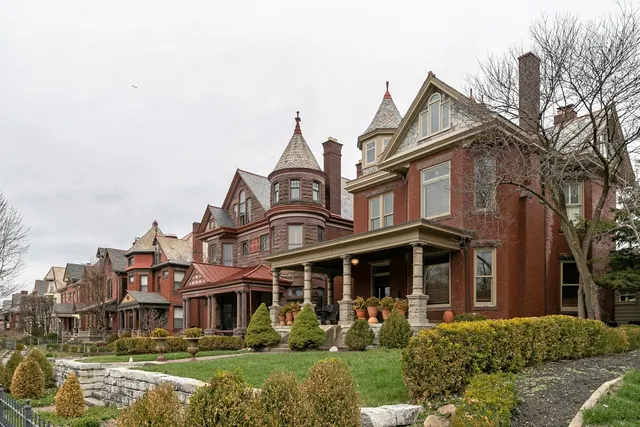
German Village is known for small brick cottages built in the 1800s, set close together on narrow lots along brick streets. Italian Village, Victorian Village and Olde Towne East have larger brick and frame homes from the late 1800s and early 1900s. These houses typically have stone or early brick foundations, small cellars or basements, and gaps where utility lines were added through old masonry.
Rats in these neighborhoods often live along alleys, around detached garages and carriage houses, and near restaurant dumpsters in busy commercial strips. Mice move through shared walls in attached and closely spaced homes. Rodent work here leans heavily on sealing masonry gaps and coordinating with neighbors.
Clintonville ravines and the north side
Clintonville and Beechwold are cut by wooded ravines running down to the Olentangy River, and many houses back onto them. These are classic deer mouse and white-footed mouse habitats, and homes on ravine lots get steady fall mouse pressure. Squirrels are also common, so attic noises here are not always rodents of the rat-and-mouse kind. The table on our noises in walls and attics page helps tell them apart.
New subdivisions on former farmland
On the edges of Columbus and in fast-growing areas around the outerbelt, many homes were built in the past twenty years next to fields that are still farmed or recently cleared. These homes are tight, but mice still find the gaps that every new home has: the garage door corners, where the A/C line and other utilities enter the wall, and roof returns. Harvest time in September and October can send a wave of field mice into the garages of the houses nearest the fields.
In newer homes, rodent proofing is usually quick and at the lower end of the price range, and it is well worth doing before the first fall.
Student rentals and multi-family housing
The University District around Ohio State has a large stock of older houses converted to student rentals, plus apartment buildings of every age. Turnover, crowded kitchens and trash left out on move-out days are a recipe for mice and sometimes rats. Tenants should report rodent problems to the landlord in writing, and landlords get the best results by sealing and treating whole buildings rather than one unit at a time.
What rodent control costs in Columbus
Columbus prices are in line with the rest of Ohio. Mouse trapping programs usually run $200 to $500 and rat programs $250 to $650. Sealing ranges widely with the house: $300 to $800 for newer homes, $600 to $1,500 for postwar homes, and $1,000 to $2,500 for historic brick homes with stone foundations. Pages for rat removal in Columbus and mouse control in Columbus go into more local detail.
Columbus rodent seasons
Central Ohio gets a clear fall rush of mice from late September to November, driven by cooling nights and harvest in the farmland surrounding the metro. December through February is the busiest stretch for indoor complaints. Rats are most visible outdoors in spring and summer, digging burrows under decks, sheds and garages, especially in the older neighborhoods with alleys. Late summer is the best time to seal a Columbus home, before the fall mouse movement starts.
Student neighborhoods have their own rhythm. Move-out at the end of the spring semester and move-in in August leave trash, furniture and food behind, and mouse complaints in campus-area rentals often spike in early fall when new tenants find what the summer left.
Columbus suburbs and townships
The Columbus area includes many suburbs and townships around the city, and rodent problems there tend to look like the newer parts of Columbus itself: mice coming in from nearby fields, woods and creek corridors, entering through garages and utility lines. The pattern is similar from Hilliard and Dublin to Westerville, Gahanna, Reynoldsburg, Grove City and Canal Winchester, though each has its own edges of farmland and parkland. Expect quick, inexpensive sealing on newer homes and more involved work on the older village centers that some of these communities grew from.
Columbus neighborhoods we cover
- German Village
- Short North
- Italian Village
- Victorian Village
- Clintonville
- Olde Towne East
- Merion Village
- Hilltop
- Linden
- Franklinton
- University District
- Northland
- Beechwold
- Driving Park