Mentor, OH facts that affect rodent control
| Mentor fact | What it means for rats and mice |
|---|---|
| Largest city in Lake County, on the Lake Erie shore | Lake-effect snow keeps mice indoors longer; heavy December snow often brings a second wave of calls. |
| Mentor Marsh State Nature Preserve and Headlands Beach State Park sit at the north end | Large wild areas supply field and deer mice; homes nearby benefit most from sealing before fall. |
| Many ranches and split-levels from the 1950s to 1990s, often with later additions | Crawlspaces under additions and split-level slab joints are the usual mouse routes. |
| Home of the James A. Garfield National Historic Site (Lawnfield) | Older homes around the historic core have stone foundations and crawlspaces that need mortar and mesh work. |
Rodent pressure around Mentor
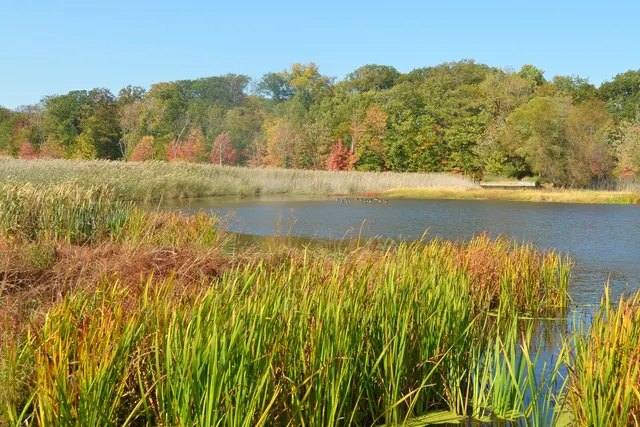
Mentor has more open land around it than most Northeast Ohio suburbs. To the north is the lakeshore, including Headlands Beach State Park and the Mentor Marsh State Nature Preserve, a large wetland with dense cover. Inland, there are wooded stream corridors, nurseries and fields along the edges of the city and toward Kirtland and Painesville. All of that is good habitat for field mice and deer mice.
The result is a strong, predictable fall mouse season. Lake-effect weather extends it: the lake keeps early fall a little milder, but late fall and winter are long and snowy, and mice that come inside tend to stay well into spring.
Mentor homes and their weak spots
Much of Mentor was built from the 1950s through the 1990s, with lots of ranches, split-levels and two-story colonials. Each layout has its own soft spots:
| House type | Common rodent entry | Where mice end up |
|---|---|---|
| Ranch on a crawlspace or slab | Crawlspace vents, garage door, utility lines | Kitchen, crawlspace, attic |
| Split-level | Gap where the lower level slab meets the walls, garage | Lower family room, laundry, between floors |
| Two-story colonial | Garage, roof returns, A/C line set | Kitchen, attic, bonus room |
| Older homes near the Headlands | Foundations, crawlspaces, cottages converted to year-round use | Basement, crawlspace, walls |
Split-levels deserve a special mention. The space between the lower and upper floors, and the joint where the lower slab meets the framing, give mice a sheltered highway through the middle of the house. If you hear scratching in the ceiling of a lower-level family room, that is the most likely route.
The Headlands and lakefront cottages
The neighborhoods near Mentor Headlands and along the Mentor-on-the-Lake border include older cottages and small homes, some originally built as summer places and later converted to year-round living. Many sit on crawlspaces or shallow foundations with vents and gaps that were never designed to keep rodents out. Damp lake air also makes those crawlspaces humid.
In these homes, expect a rodent proofing job to focus on crawlspace vents, access doors, and the joint between foundation and framing. Crawlspace cleanup, including replacing a torn vapor barrier, is common after a winter of mouse activity.
Rats in Mentor
Rats are not the main rodent in Mentor, but they appear around commercial corridors like Mentor Avenue, around marinas and near properties with heavy bird feeding, compost or chickens. A rat in a residential yard usually means there is a burrow nearby under a deck, shed or slab, and a food source within a few hundred feet. The rat burrow treatment page explains how that is handled.
What rodent control costs in Mentor
For a typical Mentor home, mouse trapping and follow-ups run $200 to $500. Sealing a ranch or split-level usually lands between $400 and $1,200. Older lakefront homes with crawlspaces can go higher when vents, access doors and foundation gaps all need work. Crawlspace cleanup is quoted separately, often $600 to $1,800 depending on the size of the space and whether the vapor barrier needs replacing.
If your home is near the marsh or the woods, think of sealing as the main investment and trapping as the short-term fix. Without sealing, the mice will be back next fall.
Fall checklist for Mentor homeowners
- In late August or early September, check the garage door seal and corners.
- Look at crawlspace vents and make sure screens are intact and made of metal mesh.
- Seal around the A/C line set, hose bib and dryer vent.
- Move birdseed and pet food into metal cans.
- Set two or three traps in the garage as an early warning.
- If you have a split-level, check the lower-level family room ceiling and laundry for droppings by mid-October.
Mentor homes with crawlspaces and additions
Many Mentor ranches and split-levels have had additions over the years: a family room off the back, a sunroom, an expanded garage or a bedroom wing. Additions are often built on crawlspaces or slabs even when the original house has a basement. The joint where the new foundation meets the old one is a common gap, and the crawlspace under the addition often has vents and an access door that were never rodent-proofed.
If your mouse activity centers on a family room, sunroom or bedroom that was added later, check the crawlspace under it first. Signs include droppings on the vapor barrier, torn insulation hanging from the floor joists, and gaps at the vents. Sealing the vents with metal mesh, fitting a tight access door and closing the joint between old and new foundations usually stops the problem.
Lake County weather and rodent timing
Lake County sits in the snowbelt. Lake-effect snow can bury the ground for weeks, and when it does, mice and rats are pushed toward buildings for shelter and food. The first sustained cold in October brings the initial wave of mice, and heavy snow in December and January tends to bring a second round of calls. Spring melt reveals burrows along foundations and under decks, a good time to check for rats.
Mentor neighborhoods we cover
- Mentor Headlands
- Mentor-on-the-Lake border
- Mentor Marsh area
- Center Street
- Hopkins Road
- Little Mountain area
- Heisley Road
- Garfield Road area
- Johnnycake Ridge
- Diamond Centre area