7 minute read · Updated October 2026
Confirm it is a dead rodent
Decomposition has a distinct smell: sweet and sickly at first, then stronger and more like rotten meat over a few days. It tends to concentrate in one room or one wall and grows stronger when the room is warm. Other smells get confused with it:
| Smell | Likely cause |
|---|---|
| Sweet, rotten, strongest near one wall | Dead mouse or rat |
| Musky, ammonia-like, in a cabinet or closet | Live mice and their urine |
| Rotten eggs, sulfur | Possible gas leak or dry drain trap; leave and call your gas utility if you have gas |
| Sewage | Dry floor drain trap or a plumbing vent issue |
| Fishy or burning plastic near an outlet | Overheating wiring; call an electrician |
How long the smell lasts
For a single mouse, the smell typically peaks within the first week and fades over two to three weeks. A rat is larger and can smell for four weeks or more. Warm, humid weather makes it stronger and longer; in winter, with the furnace drying the air, it can fade faster. Several rodents dying around the same time, which often happens after poison bait is spread around a house, can drag it out much longer.
Finding the spot yourself
- Go room to room and find where the smell is strongest. Close doors to isolate it.
- Along that wall, sniff at floor level, outlet height and near the ceiling. Odor spreads upward, so the strongest low spot is often close.
- Check the obvious first: behind the fridge and stove, under the dishwasher, inside the bottom drawer of the stove, the cabinet under the sink, closets that share the wall.
- Check the floor below and the space above: the basement ceiling under that room, or the attic floor above it.
- Look for flies gathering at one window, vent or outlet. They are drawn to the source.
- Check HVAC returns and ductwork if the smell seems to come through vents in several rooms.
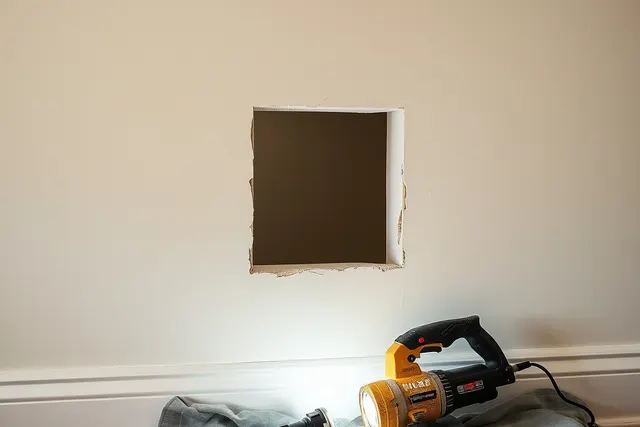
If the source is behind finished drywall, the decision is whether to cut a small opening or wait.
Wait it out or remove it?
Waiting is a reasonable choice when it is one mouse, the smell is mild, it is in a room you can close off, and the weather is cool. Ventilate the room, use an activated charcoal or odor absorber nearby, and give it a couple of weeks.
Paying for dead rodent removal makes sense when the smell is in a bedroom, nursery or kitchen; when flies are appearing; when it is a rat; when it is summer; or when there may be more than one. In Ohio, removal typically costs $150 to $450 depending on whether a wall has to be opened. Technicians use inspection cameras through outlet boxes and small holes to pinpoint the spot, so the patch afterward is usually small.
Cleaning up after the carcass is out
Wear gloves. Spray the carcass and the area with a disinfectant, wait a few minutes, then remove it with a bag turned inside out and seal it in a second bag. Spray the cavity with an enzyme-based odor cleaner, which breaks down the compounds causing the smell rather than covering them. Remove any soaked insulation or nesting material nearby. Patch the wall once the smell is gone.
Why it happened and how to prevent the next one
A dead mouse in a wall nearly always traces back to two causes. First, mice had access to the wall cavity, usually through a gap at the sill plate, a pipe hole under a sink or a gap at the roofline. Second, poison was used somewhere in the house or garage, and the mouse ate it and went home to its nest to die.
Switching to snap traps for any remaining activity, as described on our mouse control page, means you find what you catch. Closing the gaps that let mice into the walls, covered under noises in walls and attics, stops the cycle. If you are still hearing scratching in other walls, there are live mice in the house and the problem is not over.
A note on renters
If you rent, tell your landlord or property manager in writing as soon as you notice the smell. In Ohio, landlords are generally responsible for keeping rental units fit and habitable, and dealing with a rodent problem and the damage it causes is usually part of that. Keep a photo log of droppings, holes and the date the smell started.
Checking behind appliances and cabinets
Kitchens hide more dead mice than any other room because of the toe-kick space under the cabinets. That gap behind the thin board at the bottom of the cabinets is a sealed-off void where mice travel and sometimes die. Many toe-kick panels pop off with a putty knife, and a flashlight and phone camera pushed into the space will show you the length of the cabinet run without cutting anything.
The dishwasher is another common spot. Remove the lower kick plate (usually two screws) and look underneath with a flashlight; the insulation blanket around the tub is a popular nesting place. Behind the refrigerator, check the coil area at the bottom and the compressor compartment at the back, where it is warm. Unplug the fridge before reaching in. A stove drawer and the space behind the range are also worth a look, especially if mice had been getting into the pantry.
Odor control while you wait
- Ventilate: open windows in the room and use a box fan blowing outward.
- Absorb: bowls of activated charcoal, baking soda or coffee grounds near the wall help a little in a closed room.
- Isolate: close the door and lay a rolled towel at the bottom if the smell is in a bedroom.
- Do not seal the wall with spray foam or caulk to trap the smell; the odor and flies find another way out.
- Do not spray pesticides into the wall to kill flies; it just adds chemicals to the problem.
If you are finding fly larvae or small beetles coming from an outlet or baseboard, removal is the faster route; the carcass is attracting a second set of pests.