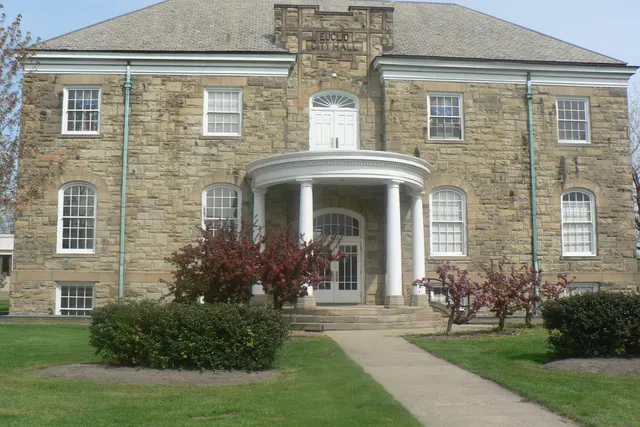
Euclid, OH facts that affect rodent control
| Euclid fact | What it means for rats and mice |
|---|---|
| Euclid has several miles of Lake Erie shoreline | Damp lake air keeps basements humid, giving mice water and making dehumidifying part of cleanup. |
| Euclid Creek Reservation (Cleveland Metroparks) runs through the city | Wooded creek valley homes get deer mice; wet down droppings in sheds and garages before cleaning. |
| Housing ranges from 1920s brick and frame homes to postwar bungalows and lakefront apartments | Older homes need foundation sealing; apartments need building-wide treatment through shared basements. |
| Long industrial history along the lakefront rail corridor | Rail and industrial land near older blocks supports rats that move into nearby garages and yards. |
Lake Erie and rodents in Euclid
Euclid's location on the lake has two effects on rodent activity. First, the lake keeps the air damp most of the year, which makes basements humid. Mice and rats both need water, and a damp basement with a dripping laundry tub or a sweating water line gives them a steady supply. Second, cold winds off the lake and lake-effect snow push the cold season longer into spring, so mice that come indoors in October often stay until April.
Homes along Lakeshore Boulevard and the streets just south of it tend to have the dampest basements and the longest mouse seasons. Homes up the hill toward Chardon Road and Euclid's southern edge are drier but see more pressure from the wooded ravines and parks.
Euclid housing and where rodents get in
Euclid grew in waves. The neighborhoods closest to the lake and to the old industrial corridor have many 1920s brick and frame colonials and doubles, often with stone or early block foundations. Postwar bungalows and small ranches fill much of the middle of the city, and there are large apartment complexes along the lakefront and near the freeway.
In the 1920s houses, the usual entry points are failing mortar in the foundation, old basement windows, and gaps where utility lines were added through the walls over the decades. In postwar homes, it is more often weep holes in brick veneer, the sill plate, and the garage. In apartment buildings, rodents usually move through shared trash rooms, utility chases and basements, and treatment is typically arranged by the building owner.
Euclid Creek and park-edge mice
The Euclid Creek Reservation, part of the Cleveland Metroparks system, runs through the southern and western parts of the city in a wooded valley. Homes that back onto the creek valley and other green spaces in Euclid see more deer mice and white-footed mice, which move from the woods into garages, sheds and basements as nights cool off. Deer mice carry a higher health risk because they are the main carrier of hantavirus, so droppings in a shed or garage near the woods should be wetted with disinfectant before cleanup, never swept dry.
If you live near the creek or a park, set a couple of traps in the garage in early fall and look at the garage door seal before the first cold nights.
Rats in Euclid
Norway rats in Euclid tend to concentrate in the older, denser neighborhoods near the lake and the industrial corridor, around detached garages, overgrown lots and commercial dumpsters. A rat seen in a yard on a residential street often traces back to a food source a few lots away: a bird feeder, an open compost pile, or pet food left outside.
If you are seeing rats rather than mice, the approach changes. Rat removal involves exterior stations and burrow work as well as trapping inside, and sealing has to use heavier materials because rats chew through things mice cannot.
Damp basements and droppings cleanup
A humid Euclid basement is a good environment for mold as well as mice, and the combination makes cleanup more important. Mouse urine and droppings in a damp corner, a stored box or a fiberglass ceiling tile can stay smelly much longer than in a dry space. After the mice are dealt with, wet down and disinfect any droppings, throw away contaminated cardboard and ceiling tiles, and run a dehumidifier to keep the space dry. Our droppings cleanup page goes into the details, including when it is worth hiring the job out.
What rodent control costs in Euclid
Euclid prices sit in the normal Cuyahoga County range. A mouse trapping program usually runs $200 to $500, rat removal $250 to $650, and sealing an older Euclid home $500 to $1,500 depending on the foundation and how many gaps there are. Postwar homes often fall at the lower end of the sealing range. Damp-basement cleanup is quoted separately and varies with how much needs to be removed.
For rental doubles and small apartment buildings, ask about treating all units at once. Mice move between units through shared walls and basements, and a whole-building approach is usually cheaper than treating one unit at a time.
Euclid rodent timing through the year
Euclid's mouse season starts in October as lake winds turn cold and runs well into April. Snowy winters keep mice in walls and basements longer than in southern Ohio. Spring is when attic and basement damage gets discovered, and summer is the season for exterior sealing on older foundations, when mortar sets well and the ground is dry enough to work along the foundation.
Euclid neighborhoods we cover
- Euclid Beach area
- Lakeshore Boulevard
- Shore Cultural Centre area
- Euclid Creek
- East 222nd Street
- Babbitt Road
- Chardon Road hill
- Upson area
- Recher area
- Indian Hills